

Level I Thermography Certification
Level 1 Thermography Overview
This course is an introduction to the laws of thermodynamics, temperature, the electromagnetic spectrum, and basic thermal camera use. This Level I Thermography Course fulfills the requirements for Level I Thermal/Infrared Certification as specified by the American Society for Nondestructive Testing (ASNT). Level 1, Level 2, and Level 3 Thermography courses follow the ASNT -recommended course curriculum. Our training meets or exceeds ASNT-TC1A and ASNT CP-189. Special consideration can be made to meet or exceed ISO 9712 with the required 2 weeks or 80 hours of training.
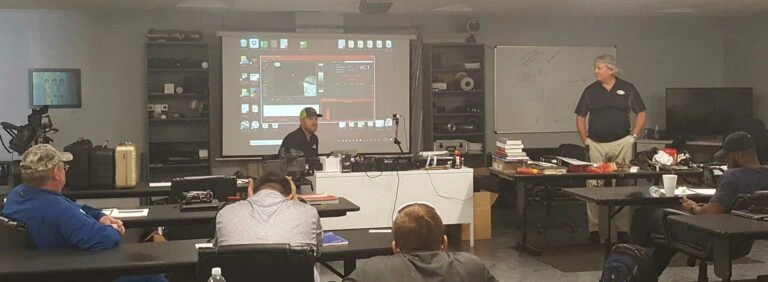
On conclusion of this course, every trainee must show their abilities, not only in operating their infrared device, but also in accurate temperature measurement, inspection, and data finding. Students can receive the certification only after passing the written exams. 32 hours of training is required for certification.
We limit class size to ensure all students receive the necessary personal attention required to make their training experience a complete success. Each student learns to operate their thermal imaging camera, making use of all features and functions available for their specific application. We cover a wide range of inspection applications including electrical, mechanical, petrochemical, building envelopes, etc.
Preface
- Normal view on the application of Infrared Thermography
- Course logistics and curriculum outline
- Instruction and student introduction session
- Comprehending certification and requirements
Basic Infrared / Thermal Physics
The Basic Physics of Matter
- Matter – Definition and basic principles
- Energy – definition and basic principles
Heat and Temperature
- What is it and how it’s measured/expressed
- Basic relation of heat temperature and energy
Heat Transfer
- Conduction Fundamentals
- Convection Fundamentals
- Fourier’s Law (concept)
- Conductivity/Resistance Basics
- Practical application of conductivity in thermography
- Practical application of convection in thermography
- Newton’s Law of cooling
- Radiation Fundamentals
- Planck’s Law
- Wien’s Law
- Stephan Boltzmann Law
Radiosity
- Reflection, Transmission, Emission
- Radiometry and Imaging
- Spatial Resolution Concepts
Infrared Equipment Operation
- How your imager works
- Equipment overview/features
- Operation of equipment
- Controls
- Lenses
- Getting a good image
- Clarity (focus)
- Thermal Focus
- Dynamic Range
- Recognizing and Dealing with Reflections
- Recognizing and Dealing with Convection
Temperature Measurement
- Measurement functions
- Performing accurate temperature measurement
- Performing emissivity measurements
- Avoiding errors
- Small spot size
- Distance
- Atmospheric Attenuation
The Environment and Support Equipment
- Environmental Data
- Support Equipment for Inspections
Applications
- Qualitative vs Quantitative Inspections
- Electrical Inspections
- Mechanical Inspections – Friction
- Thermal Resistance – insulation & refractory
- Thermal Capacitance – roof moisture surveys
- Physical State – Gas/Liquid, Liquid/Solid
- Process Inspections
- Fluid Flow
- Steam
- Vessel levels
- Building Inspections
- Miscellaneous – student selected applications
Reports / Software
- Introduction
- Software programs
- Making Reports
- Making Templates
- Printing reports
Level 1 Examination
Level 1 Infrared Thermography Manual Outline
Section 1 Introduction
-
Infrared Thermography▼
-
Introduction to Thermography
Infrared thermography is one of the fastest growing forms of non-destructive testing in the world today. The ways in which we can use this technology are only limited by our imagination. -
Level I Certification Course Outline
This course meets or exceeds the recommended training requirements of ASNT-TC-1A for Level I Thermal/Infrared Certification. Review of the course outline. -
Certification Procedure and Requirements
ASNT – TC – 1A recommends that the required classroom instruction for a Level 1 thermographer is 32 hours. In keeping with these requirements, the candidate must attend the Level 1 Thermographer Training course as administered by Infrared Training Institute and pass the written examination with a grade of 70% or more. -
Thermography Course Schedule
Each student will receive course materials at these ASNT compliant courses including but not limited to: a comprehensive manual, course handouts, administration and grading of examination as well as Certification to those who meet the written requirements.
-
Section 2 The Foundation: Basic Thermal Physics
-
Basic Thermal Physics▼
-
The Basic Physics of Matter
Physics is the study of nature or natural things. The word in today’s world speaks of a branch of science that is the study of nature at its fundamental level. It deals with the behavior of atoms, gravity, electromagnetism etc. -
Thermal Analysis and Infrared Thermography
Infrared thermography is one of the newest Industrial/Commercial Research and development testing techniques. Unlike X-ray which has been in use for over 100 years or Doble Testing which has been conducted for over 75 years, infrared thermography began in the 1960’s and gained general acceptance in the 1970’s. -
The History of Thermal Analysis and Thermography
Tracing the evolution of heat detection from early discoveries to the development of modern thermal imaging technologies. -
Introduction to Temperature
Temperature is one of the most important features of the natural world in which we live. It is also the most frequently used measurement of a physical property. -
Temperature: Global Warming, and the Weather
In the past Climate Researchers have been unable to accurately determine how much of the earth's thermal energy commonly known as “heat” travels through the earth’s atmosphere and how much travels through the oceans. -
Matter
All objects in the world, whether they be solids, liquids or gasses, are made up of molecules. -
Solids, Liquids and Gasses
Matter exists in three primary states: solids maintain a fixed shape and volume, liquids have a definite volume but adapt to their container's shape, and gases expand to fill both the shape and volume of any enclosure. -
Energy
All objects in our natural world also contain energy. -
Temperature (Perception vs exact)
Many people confuse temperature with the concept of hot and cold. It must be recognized that the perception of hot and cold is a relative idea while the concept of temperature is a well defined, exact value that does not change under varying relative conditions. -
The Art of Measurement
Techniques of measurement and of mathematical analysis are of basic importance to a physicist. The high measurability of the phenomena involved sets the physical sciences apart from the others and permits them to be called exact sciences. -
Thermometers
Thermometers are devices used to define and measure the temperature of a system. A thermometer in thermal equilibrium with a system measures both the temperature of the system and its own temperature. -
Temperature Scales
Fahrenheit, Celsius, Kelvin, and Rankine scales. -
Heat
When the thermal energy is transferred between the two objects as a result of strictly a difference in temperature, the process is called Heat.
-
Section 3 Basic Heat Transfer
-
Basic Heat Transfer▼
-
Heat
Heat is defined as energy being transferred or in transit from one place to another as a consequence of temperature differences only. -
Thermodynamics
The science of heat transfer has evolved from three fundamental concepts “laws” of thermodynamics , the first and second law being the most important. -
Change of State
While change of state is not considered a true mode of heat transfer, the principles of latent heat do have a number of practical applications in infrared thermography and are worth considering. -
Conduction
The transfer of energy from areas of higher temperature to areas of lower temperature by the intimate contact of the molecules. -
Convection
The transfer of energy from areas of higher temperature to areas of lower temperature by the movement of a fluid. -
Wind Chill
The weatherman tells you that the temperature is going to be cold but bundle up because the wind chill factor is going to make it feel really cold out there. What does that mean and why would the wind make it feel even colder than it really is. -
Heat transfer by Radiation
Heat transfer by radiation takes place primarily in the area of the electromagnetic spectrum known as the infrared band. -
Radiation
The transfer of energy, through a gas or a vacuum, from objects at higher temperatures to objects at a lower temperature by means of alternating electromagnetic waves.
-
Section 4 Electromagnetic Radiation
-
Overview: Electromagnetic Radiation▼
-
Electromagnetic Radiation Basics
You may not realize it, but every moment of your life, from birth to death, you are being constantly bombarded by electromagnetic radiation. -
The Electromagnetic Spectrum
The electromagnetic spectrum is a chart of energy, which describes the full range of known electromagnetic radiation types. -
Radio Waves
All objects in the universe give off radio waves, as all objects are above absolute zero. -
Microwaves
In 1924 Marconi developed “The Beam System” which was the beginnings of microwaves. -
Infrared
The infrared portion of the spectrum is from 1 – 1000 microns. All objects above absolute zero emit radiation in the form of infrared rays. -
Night Vision
In general most night vision devices are electro-optical devices, which amplify available light in low light scenes such as night time conditions. -
Infrared Thermography
Infrared thermographic instruments are non-contact, non-intrusive systems that see only radiated energy from the 1/1000” of most objects. -
Infrared Film
In the daylight, infrared film will pick-up reflections off objects and not the heat emission from these objects. -
Visible Light
The visible area occupies the band width from .38 - .72 microns. Wavelengths are associated with temperatures of 525 degrees Celsius or higher. -
Ultraviolet
Ultraviolet radiation as the name suggests is electromagnetic radiation that is just off the violet end of the visible spectrum. -
X-Rays
Discovered in 1895, X-rays are much shorter than ultraviolet rays and can penetrate many solids.
-
Section 5 Radiation Laws and Emissivity
-
Overview: Infrared Radiation and Emissivity▼
-
Infrared Radiation Physics – Introduction
For a complete understanding of the infrared image one must have a background into some of the basic physics behind infrared radiation. -
Blackbody: Definition
A blackbody is a theoretical object that emits a maximum amount of energy at all temperatures in all wavelengths. -
Stephan–Boltzmann Law
Determined that the amount of energy radiated by an object is proportional to the object's temperature in Kelvin raised to the 4th power. -
Wien’s Law
Most objects emit energy at many wavelengths. However there is one specific wavelength at which there is a maximum amount of energy emitted. -
Planck’s Law
Max Planck established the quantum theory in which radiated energy consists of discrete quantities of energy he called photons. -
Radiated Energy Sources: The Real World
Your thermal imaging camera senses radiated energy that can come from 3 distinct sources. -
Emissivity
Emissivity is the rate at which an object emits energy compared to that of a blackbody at a given temperature and wavelength. -
Determining Emissivity Using an Infrared Imaging Radiometer
One of the greatest problems related to calculating temperature using an infrared system, is that of emissivity. -
Infrared Camera Principles
In the past, most of the infrared equipment available used scanning technology. -
Introduction: Focal Plane Arrays
Focal plane arrays have been commercially available for a number of years now. -
Basic Principles
All infrared instruments work on the same general principle. The energy radiated by an object is focused on the detector and converted to an electrical impulse. -
Detector Types
One way of classifying FPA’s is to divide them up into detector types. There are four main classes of detectors available today. -
Detector Readout
There are basically two types of readouts in systems today. One is known as a Charged Coupled Device (CCD) and the other is a Complimentary Metal Oxide Semiconductor (CMOS). -
Nonuniformity Correction (NUC)
All FPA detector elements have a nonuniform response to thermal energy. -
Fill Factor
While considering the readout capabilities of a detector, one should also address the fill factor parameters. Not all areas on an FPA detector element are sensitive to IR radiation. -
Quantum Well FPAs
Quantum wells work through a quantum mechanical interaction between photons and electrons in a quantum well structure. -
Pyro electric /Ferro-electric FPAs
The pyro electric effect is a change in polarization of a pyroactive material as a consequence of a change in temperature of the material. -
Hybrid Arrays
A typical Ferro-electric hybrid array is made by solder bonding the pyroelectric array to a corresponding array of input pads on a CMOS readout circuit. -
Integrated Arrays
Integrated arrays are made by depositing a thin pyroelectric layer directly onto a CMOS silicon wafer. -
Photon Detectors
Most cooled photon detector FPAs are made using Indium Antimonide (InSb) or Mercury Cadmium Telluride (MCT) Schottky Barrier cooled detectors. -
Microbolometers
Although it is classified as an uncooled device, these systems must have some type of temperature stabilization to prevent drift. -
Variable Integration Time
Unlike single element systems, the ability to look at higher temperatures cannot be achieved using apertures with FPA systems.
-
Section 6 The Infrared Image
-
Overview: The Infrared Image▼
-
The Infrared Image: Introduction
The infrared image that appears on your camera screen is a representation of the radiated energy that is given off of the surface (1/1000”) of objects in the field of view above approximately –35° C. -
Thermographic Camera Operation
Infrared thermography can be broken down into two basic categories: qualitative and quantitative inspections. -
Atmospheric Attenuation
Most infrared systems work in the shortwave range of 3 – 5 microns, or the longwave range of 7 – 14 microns. -
Angle
The Angle from which you view an object at, as well as the atmosphere, can also make a difference to the amount of energy your thermal imaging camera sees. -
Infrared Image Analysis
The thermographer must have the ability to examine the thermal patterns and identify the various thermal signatures to determine first if there is a true anomaly and then determine the cause of that anomaly. -
The Infrared Image and Camera Resolution
The infrared image that you view on your screen or in your eyepiece is an image that is made up of a large number of picture elements or pixels. Each of these pixels represents a small spot of the scene, which we are viewing with our camera. -
Field Of View (FOV)
The total area that our camera sees is defined by the FOV angle given by the manufacturer for each specific lens. -
The Instantaneous Field of View (IFOV)
The IFOV value describes the smallest spot that your system can geometrically resolve or see the size and shape of. It is given by an angle defined in milliradians. -
Infrared Lenses
Infrared lenses are made from expensive specialty materials. The most common lens materials are germanium, sapphire, and silicon. -
Infrared Windows
There are a number of transparent infrared window materials. Some examples are sapphire, Irtran, Germanium, (thin) Polyethylene film, and some new fluoride materials.
-
Section 7 Application Notes
-
Application Notes▼
-
Introduction
Infrared thermography is employed on a wide range of applications. While many of these applications are based on temperature, many others use object characteristics such as emissivity/reflection, or transmittance differences, while there is no variation in temperature. In general there are two types of thermographic applications, these are passive applications and active applications. -
Report Formats
There is no one “perfect” report format for infrared inspections. The format is usually dictated by the environment in which you work. -
Electrical Inspections
The inspection of electrical components was the first big commercial use of infrared thermography back in the mid 1960’s. -
Mechanical Inspections
As with electrical inspections, mechanical inspections are also based on the first law of thermal dynamics. The energy that is applied to a system must be exactly accounted for. -
Mechanical Reports
The mechanical report should have all temperature and associated pertinent information included. -
Equipment List
Review of equipment suitable to be included in a mechanical inspection program. -
Process Inspections
Process inspections with infrared thermography cover a wide variety of situations. -
Building Inspections
In some climates, building inspections are seen as a valuable role for infrared thermography. -
Specific Heat
The specific heat of a body is defined as the amount of thermal energy Q required to raise the temperature of a unit mass of the material 1° C. -
Conventional Built-up Flat Roofs
Although the roof is a part of a building, it should be treated as a separate item. The hardest part of dealing with a roof leak is often locating it.
-
Section 8 Appendix
-
Appendix▼
-
Getting A Good Image Workshop
The object behind this workshop is to get a good infrared image by using the manual adjustments on the camera. -
Ambient Reflection Workshop
The ambient reflected quantity that you must enter into your system is not necessarily a true temperature value. -
Performing Inspections Workshop
Qualitative Inspection and Quantitative Measurement. -
Hot Spot or Not
We will often see hot spots in our infrared image that are not really hot at all. Our infrared cameras do not see temperature, they see radiated energy!
-