

Blackbody Radiation
Blackbody radiation is the thermal electromagnetic radiation emitted by an idealized, non-reflective object in thermodynamic equilibrium. A perfect blackbody absorbs all incident radiation regardless of wavelength, making it a "perfect absorber" and, consequently, a "perfect emitter." As its temperature increases, the intensity of the emitted radiation rises significantly, and its peak wavelength shifts from the infrared into the visible and ultraviolet spectrums. This phenomenon is governed by three fundamental principles: Planck’s Law, which describes the spectral distribution; the Stefan-Boltzmann Law, which relates total energy to the fourth power of temperature; and Wien’s Displacement Law, which explains why hotter objects appear bluer as their peak emission shifts toward shorter wavelengths.
In a blackbody, Absorptance (α) equals Emissivity (ε), where α = ε = 1.
Practical objects include transmittance (τ) and reflectance (ρ), defined by:
Planck’s Law
Energy radiated from a blackbody is described by Planck’s Law:
Stefan-Boltzmann Law
Integrating Planck's Law over all wavelengths (0 to infinity) yields the total radiant emittance:
Wien’s Displacement Law
Differentiating Planck’s Law to find the peak wavelength results in Wien’s Displacement Law:
Constants and Variables
- Wλ : Spectral radiant emittance [W/cm²·μm]
- λm : Wavelength of maximum emittance [μm]
- T : Absolute temperature [K]
- h : Planck’s constant = 6.6261 × 10⁻³⁴ [W·s²]
- c : Light velocity = 2.9979 × 10¹⁰ [cm/s]
- k : Boltzmann constant = 1.3807 × 10⁻²³ [W·s/K]
- σ : Stefan-Boltzmann constant = 5.6705 × 10⁻¹² [W/cm²·K⁴]
Spectral Radiant Emittance Analysis
For normal objects, multiply the blackbody equations by emissivity ε (where ε < 1).
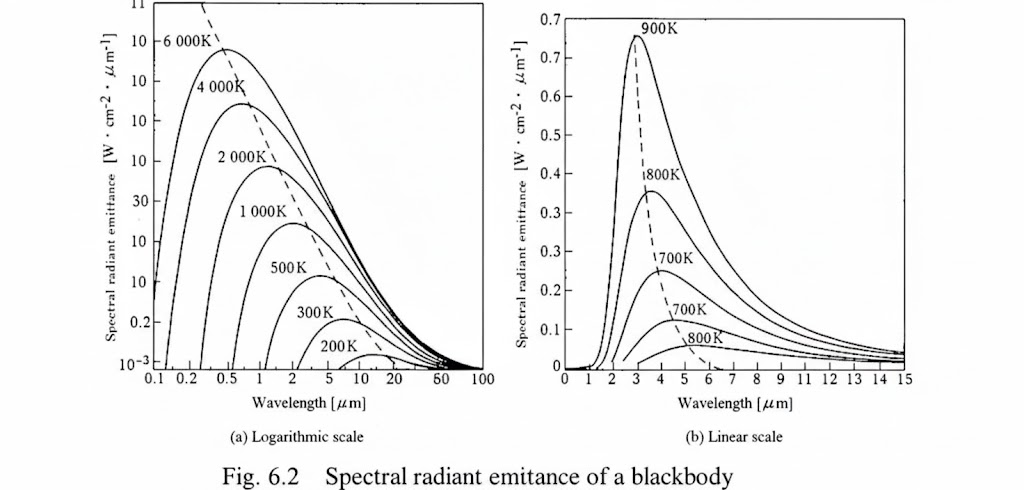
As temperature rises, the peak shifts to shorter wavelengths. This explains why objects transition from red to yellow to white as they heat up.