
Infrared Thermography Practical Measurement & Emissivity Correction
To obtain accurate temperature readings, you must correct for emissivity (ε). If the emissivity of your target is unknown, use one of the four practical methods below.
1. Comparison with an Integrated Blackbody
This is the most accurate method, creating a "perfect" reference point on the object itself.
- Drill or identify a small, deep hole in the object to act as a cavity blackbody .
- Adjust the camera's emissivity setting until the surface temperature matches the temperature read from the hole.
- The resulting value is the true emissivity of the surface.
2. Surface Modification (Black Paint)
Used when a hole cannot be drilled into the target.
- Apply high-emissivity black paint or tape to a section of the target.
- First set the emissivity of the black paint and then measure the temperature of the painted area.
- Calibrate the camera to the unpainted surface by matching its temperature to the painted reference.
3. Indirect Contact Comparison
Useful for lab settings or small samples.
- Heat the object and a similar reference sample simultaneously.
- Verify the surface temperature of the sample using a contact-type thermometer (thermocouple).
- Adjust the IR camera emissivity until the thermal image temperature matches the contact probe reading.
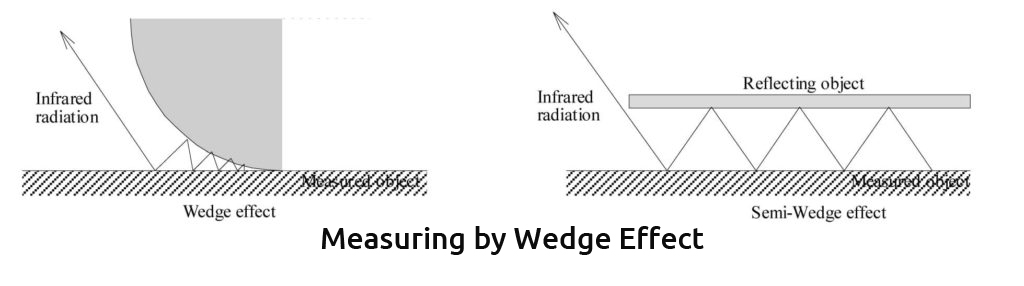
4. The Wedge Effect
Enhances natural emissivity by manipulating the geometry of the target.
By creating a "V" shape or wedge, multiple internal reflections increase the effective emissivity of the material. Note: Measurement accuracy depends on the number of reflections and the specific viewing angle.