Level 2 Program Overview
This Level II Thermography Course is structured to fulfill the training standards for Level II Thermal/Infrared Certification as specified by the American Society for Nondestructive Testing (ASNT). The curriculum combines audio, visual, and practical hands-on training to guarantee thorough comprehension.
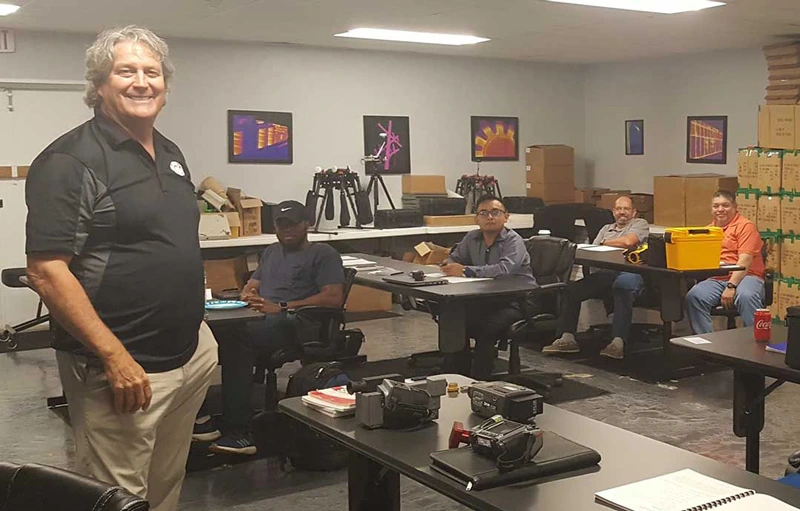
Students will acquire expertise in operating infrared thermal imaging systems and understanding their technical specifications and operational capabilities. Upon course completion, participants must exhibit proficiency not only in using infrared cameras but also in precisely measuring temperatures, performing inspections, and analyzing thermal data.
Certification is granted exclusively upon successful completion of a comprehensive written examination. Class enrollment is deliberately limited to ensure optimal interaction between instructors and students.
Module 1Introduction
Overview of Infrared Thermography
▼
Review current applications where infrared thermography is relevant.
Course Logistics and Outline
▼
Review course schedule, curriculum, materials, and objectives.
Student and Instructor Introductions
▼
Establish connections through introductions, sharing professional backgrounds and certification goals.
Certification Process and Requirements
▼
Understand ASNT certification standards, examination format, passing criteria, and recertification procedures.
Module 2Fundamentals of Thermal Physics
Basic Physics of Matter
Definition and Core Principles of Matter and Energy
▼
Study the fundamental concepts of matter, energy states, molecular structure, and atomic behavior as they relate to thermal imaging detection.
Heat vs. Temperature: Definitions and Measurement
▼
Learn the critical distinction between heat (energy transfer) and temperature (energy measurement) and various temperature scales.
Relationship Between Heat, Temperature, and Energy
▼
Explore how thermal energy, heat transfer, and temperature measurements interact, including specific heat capacity and thermal mass.
Heat Transfer Mechanisms
Conduction
▼
Master heat transfer through direct contact between materials and its implications for thermal imaging.
Fundamentals and Fourier's Law
▼
Understand the mathematical relationship governing heat
conduction and temperature gradients.
Thermal Conductivity and Resistance
▼
Learn how materials conduct heat at varying rates and interpret these properties in thermal images.
Real-World Applications in Thermography
▼
Apply conduction principles to identify thermal anomalies in electrical, mechanical, and building systems.
Convection
▼
Examine heat transfer through fluid motion and its role in thermographic interpretation.
Newton's Law of Cooling
▼
Study how objects cool through air or liquid movement and the rate of heat loss.
Thermographic Relevance and Application
▼
Recognize
convection effects in thermal images and account for environmental air movement.
Radiation
▼
Master the fundamental mechanism behind infrared thermography—electromagnetic energy emission.
The Electromagnetic Spectrum
▼
Understand where infrared energy fits within the electromagnetic spectrum and wavelength ranges.
Planck's, Wien's, Stefan-Boltzmann Laws
▼
Learn foundational physics laws governing thermal radiation and temperature relationships.
Radiosity: Emission, Reflection, Transmission
▼
Master how surfaces emit, reflect, and transmit infrared energy and understand
emissivity values.
Module 3Radiometry and Imaging Techniques
Understanding Spatial Resolution
▼
Learn how camera resolution affects detection capability, including instantaneous field of view and spot size ratios.
Equipment Overview: Components and Features
▼
Examine infrared camera components including detectors, lenses, displays, and recording systems with their specifications.
Infrared Camera Operation
▼
Develop hands-on proficiency with thermal imaging equipment through comprehensive operational training.
Controls, Lenses, and System Navigation
▼
Master camera menu systems, button functions, and lens selection for different inspection scenarios.
Achieving Image Clarity and Focus
▼
Learn proper focusing techniques for sharp thermal images and understand depth of field principles.
Managing Dynamic Range and Thermal Focus
▼
Optimize level and span settings, adjust color palettes, and properly scale thermal ranges.
Identifying and Mitigating Image Artifacts
▼
Recognize common thermal image artifacts including dead pixels and non-uniformity corrections.
Reflection and Convection Effects
▼
Identify false readings from reflected infrared energy and understand air movement thermal patterns.
Module 4Temperature Measurement Techniques
Using Measurement Functions Accurately
▼
Master spot measurement tools, area boxes, line profiles, and temperature differentials for reliable data collection.
Emissivity Measurement and Adjustments
▼
Learn methods to determine
emissivity values for various materials and properly adjust camera settings.
Error Sources and Mitigation
▼
Identify and correct common measurement errors that compromise temperature accuracy.
Spot Size, Distance, Atmospheric Effects
▼
Understand how distance affects accuracy through spot size ratios and atmospheric absorption factors.
Module 5Environmental Considerations
Assessing and Recording Environmental Data
▼
Learn to document ambient temperature, humidity, wind speed, and atmospheric transmission affecting measurements.
Utilizing Support Equipment During Inspections
▼
Master supplementary tools including contact thermometers, hygrometers, and emissivity reference targets.
Module 6Practical Applications
Medical and Veterinary Uses
▼
Explore thermography in healthcare for inflammation detection, vascular assessment, and animal health monitoring.
Inspection Techniques
▼
Master comprehensive inspection methodologies across industrial and commercial applications.
Qualitative vs. Quantitative Inspections
▼
Understand comparative thermal pattern analysis versus precise temperature measurements.
Optical Gas Imaging
▼
Learn specialized techniques for detecting hydrocarbon gas leaks using infrared cameras.
Electrical and Mechanical Inspections
▼
Identify overheating connections, unbalanced loads, and mechanical wear through thermal signatures.
Friction, Resistance, Capacitance
▼
Detect excessive friction, insulation deficiencies, and moisture intrusion patterns.
Process Monitoring
▼
Apply thermography to industrial process oversight and optimization.
Fluid Flow, Steam, Vessel Levels
▼
Visualize fluid movement, verify steam trap operation, and determine liquid levels.
Specialty Inspections
▼
Explore advanced thermography applications across unique inspection scenarios.
Aerial Inspections via UAV/UAS
▼
Learn drone-based thermal imaging for solar panels, power lines, and large facility inspections.
Building and Flat-Roof Assessments
▼
Identify moisture damage, insulation defects, and energy loss in building envelope systems.
Custom Applications
▼
Explore additional applications based on student interests and industry-specific requirements.
Module 7Reporting and Software
Introduction to Thermographic Reporting Software
▼
Become familiar with professional thermography software for data analysis and report generation.
Creating Reports and Templates
▼
Learn to create professional inspection reports with thermal images, annotations, and analysis results.
Exporting and Printing Final Reports
▼
Master file formats, export options, and professional presentation of thermographic findings to clients.
Final Assessment
Comprehensive Written Exam and Certification Award