

Basics of Infrared Technology
Infrared (IR) light wavelengths are invisible to the human eye, as they exist just beyond the edge of the visible spectrum (> 700 nm to 1 mm) and do not trigger photo receptors.
| Name | Wavelength | Frequency (Hz) | Photon energy (eV) |
|---|---|---|---|
| Gamma ray | less than 10 pm | more than 30 EHz | more than 124 keV |
| X-ray | 10 pm – 10 nm | 30 EHz – 30 PHz | 124 keV – 124 eV |
| Ultraviolet | 10 nm – 400 nm | 30 PHz – 750 THz | 124 eV – 3.3 eV |
| Visible | 400 nm – 700 nm | 750 THz – 430 THz | 3.3 eV – 1.7 eV |
| Infrared | 700 nm – 1 mm | 430 THz – 300 GHz | 1.7 eV – 1.24 meV |
| Microwave | 1 mm – 1 meter | 300 GHz – 300 MHz | 1.24 meV – 1.24 μeV |
| Radio | 1 meter and more | 300 MHz and below | 1.24 μeV and below |
Infrared thermography is one of the fastest growing forms of non-destructive testing in the world today. The ways in which we can use this technology are only limited by our imagination. The basic premise behind this discipline is that all objects above absolute zero (-459 F, -273 C) give off invisible infrared radiation when a suitable medium is present (a gas or a vacuum). This radiation is a function of a number of different object characteristics, only one of which is temperature. Many are under the assumption that an infrared device measures temperature. The truth is, infrared radiometers, whether they are a simple $100 small hand held radiometer or a $100,000 precise imaging radiometer, do not measure temperature. They all only measure radiated energy given off from the first 1/1000 of an inch. This energy may or may not be a function of the subject’s temperature. In many cases though, a trained thermographer armed with the necessary knowledge is capable of calculating a very precise temperature.
The Thermographer measures the temperature of a target. You have to put the proper data into the camera in order to get accurate temperature measurements. This means that setting up your camera before an inspection is important. It is also important to realize that you will be changing some of these settings in your camera during your inspection. (Of course this depends on the scope of equipment that you’re inspecting.) When we measure anything we compare it to a standard. Keep in mind that temperature measurements can be relative to the overall environment.
To See the Invisible
How do you see what can't be seen? To answer that question, we need to answer a few other questions first. How do we see? How can you detect light that is invisible to the eye? How does this help us to "see" when there is no "light"? What other information can invisible light give us?
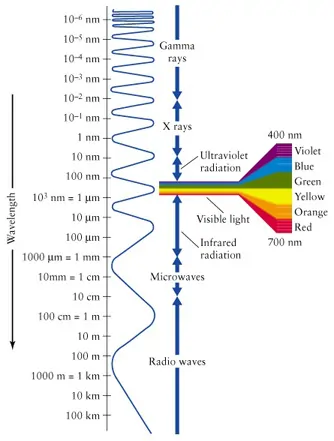
Humans, like most animals are able to see because our eyes are packed with specialized receptors that react to light and create messages that our brain interprets visually. Visible light is a type of electromagnetic radiation . This radiation is most often characterized as a wave. Visible light is comprised of waves that function on a range of frequencies that stimulate the receptors in our eyes. There are other types of radiation that function on frequencies that do not stimulate our eyes, and thus we are unable to "see" them. Some of these are radio waves, microwaves , and X-rays. This radiation is most broadly categorized with respect to spectrum of visible light. Waves with a frequency higher than the highest frequency that we can see (which produces deep purple colors) is called " Ultraviolet " or "UV". Waves with frequencies lower than the lowest frequency that we can see (the color red) are called "Infrared" or "IR".
The majority of light we see is reflected, bouncing of another object first, which is why we are able to see things. Some light we see is actually emitted, if we look at a light-bulb directly, or perhaps the sun (not recommended... it causes eye damage), or on a smaller scale a match or a candle. With the example of a candle, the combustion (burning) of the wick in air causes energy to be released. A large portion of this energy is in the form of heat, that we feel, another portion is the visible light that we see as a flame. There is also a small portion of energy released that is ultraviolet . But where there is heat, there is also Infrared. Infrared radiation(IR ray) is emitted when a material is excited on an atomic level (such as by heat), but not so much that it gives off light. Thus it gives off radiation that is of frequencies lower than our eyes can detect, but it is still there. Even with things that are not so hot, infrared radiation is still emitted. In fact, the only time something can not emit energy is when it is at a temperature called " absolute zero ", where the atoms themselves stop moving (this temperature has never been achieved).
If we know the Infrared radiation is there, how can we see it? If you remember, our eyes are able to see because the receptors react to the radiation that is in the frequencies we know as visible light. If you want to "see" infrared, you need something with receptors that will react to frequencies below visible light. Fortunately, we have such devices readily available, the digital camera. At the heart of most digital cameras is a unit called a charge-coupled device or CCD . When light strikes the device, it creates an electrical charge. This electrical charge is then interpreted into data that is then transformed into a digital image. Typical CCD's react to a wider range of frequencies than the human eye (It is important to note that if the eye reacted to infrared and ultraviolet, we would be virtually blind, everything would be too-bright and washed out, so for us, not seeing the invisible spectrum is to our daily benefit), and particularly to infrared.
As a demonstration, if you have a video or still camera that is digital, point your TV's remote control at it and press the button. You will see white flashes in display, but not with your own eyes. Something that has take real advantage of is is the Nintendo Wii so that the system knows when and where you are pointing the controller at the screen. If you apply this finding and take it further you can tune a CCD and other digital capture devices to be more sensitive to the infrared radiation. The result is a Digital Thermal Imaging Camera. Such cameras have a wide range of applications. The way they become useful is in that they receive infrared light and then translate those frequencies into those which we can see, both in a range of color and intensity.
One application of a Digital IR Camera is in thermal imaging. Hotter objects emit not only more Infrared light but also the frequency is higher, thus when translated they appear brighter and whiter. Colder items are darker and shift towards deep blues purples and blacks. (Typically the visual presentation is in a range opposite to the normal visible spectrum, but on many devices, it can be customized for the desired application or understanding, such as a simple green-red scale for cold hot respectively) Digital Thermal Imaging cameras can be used residentially, commercially, and industrially in a variety of applications, from simple temperature data collection, or for the identification of thermal inefficiencies (undesirable heat loss, absorption, or transmission) in structures such as homes, plants, or mechanical assemblies. It is also often used for safety and security, showing hidden dangers not visible to the human eye. And because thermal imaging cameras do not rely on reflected visible light, like our eyes, it allows us to see in the dark, increasing our ability to navigate, identify potential threats to safety and security, and in general improve our knowledge about the world around us.
By Gary Strahan