

Blackbody Type & Emissivity
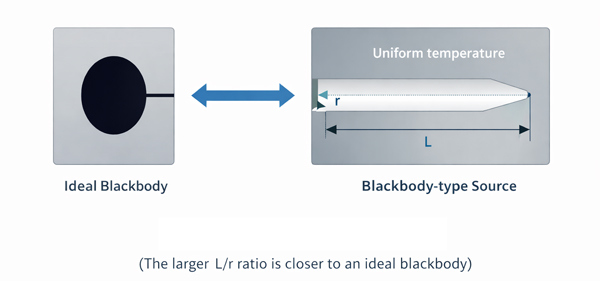
Although a blackbody is actually only a theoretical ideal, an object can be formed which approximates it. A law closely related to the blackbody is Kirchhoff’s law that defines reflection, transmission, absorption, and radiation.
Kirchhoff’s Law of Thermal Radiation
Kirchhoff’s Law of Thermal Radiation states that any object in a state of thermal equilibrium is just as good at emitting radiation as it is at absorbing it. In simpler terms, if a material is effective at soaking up heat at a specific wavelength, it will be equally effective at giving off heat at that same wavelength. This principle explains why a "perfectly black" object, which absorbs all light hitting it, is also the most efficient possible emitter of heat. Ultimately, the law ensures a balance of energy; if an object could emit more than it absorbed while at the same temperature as its surroundings, it would spontaneously cool down, which would violate the fundamental laws of thermodynamics.
- α : absorptance ( = ε : emissivity)
- ρ : reflectance
- τ : transmittance
Absorptance equals emissivity, and so emissivity can be described by reflectance and transmittance. To obtain the true temperature of an object, emissivity must be determined accurately.
The blackbody-type source can be designed to meet Kirchhoff’s condition that “the radiation within an isothermal enclosure is blackbody radiation.”
Determination of Emissivity
Emissivity is the ratio of energy radiated from an object to that radiated from a blackbody. Since emissivity varies with surface condition, temperature, and wavelength, incorrect values lead to inaccurate temperature measurements.
-
Check by literature
Literature values should be used only as references unless measurement conditions match. -
Determination by ratio (1)
Measure both the object and a blackbody-type source at the same temperature:EK : ES = 1 : X- EK: energy of blackbody-type source
- ES: energy of measured object
- X: emissivity of measured object
-
Determination by ratio (2)
Attach a blackbody-like surface to the heater and compare infrared energy ratios. -
Comparison with blackbody surface
A small hole is created to satisfy blackbody conditions and emissivity is adjusted until temperatures match. -
Black paint method
When holes cannot be made, black paint is applied and equilibrium measurements are taken.
Emissivity Example Table
| Item Name | Manufacturer | Emissivity | Measuring Wavelength |
|---|---|---|---|
| Heat-resistant paint (black) | Asahi Pen | 0.98 | 8 to 13 µm |
| Heat-resistant paint (black) | Asahi Pen | 0.95 | 3 to 5.3 µm |
| Niflon tape | Nitto Denko | 0.94 | 8 to 13 µm |