

Measuring FOV in Infrared Thermography
The total area that an infrared camera detects is defined by the FOV(Field of View) angle, given by the manufacturer for each specific lens. It works similar to a flashlight: as you move further away, the area the light covers gets larger, but the details become less visible.
The IFOV(Instantaneous Field of View) value describes the smallest spot that your system can see the size and shape. It is given by an angle defined in milliradians. If the object is too small or far away, the camera will combine the object's heat with the surrounding temperature. This is why an infrared camera might "see" a hot spot, but fail to obtain an accurate temperature measurement.
Field of View Calculator
Instantaneous Field of View for 320 → 1.2 mrad (21.7° Lens model)
Instantaneous Field of View in the distance to the object, minimum sensible dimension is represented as angle and its magnitude of the field of view. 320 are 1.2 mrad at the infinite distance as Instantaneous field of view.
Field of View Diagram
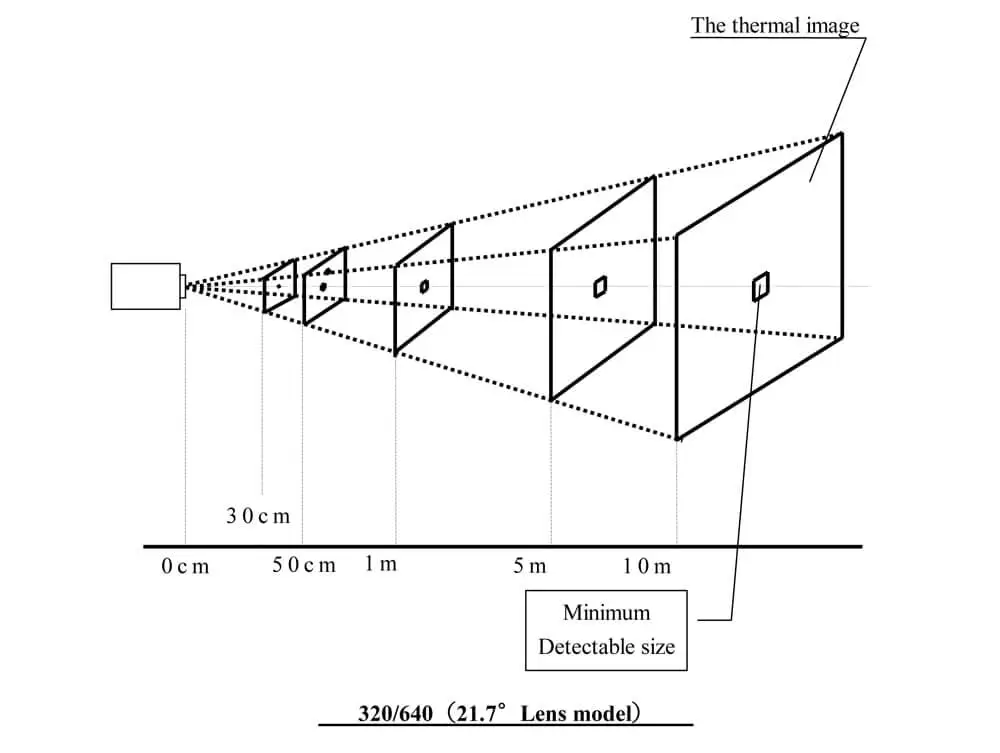
Above values are the ones when the focus is met without external lens.
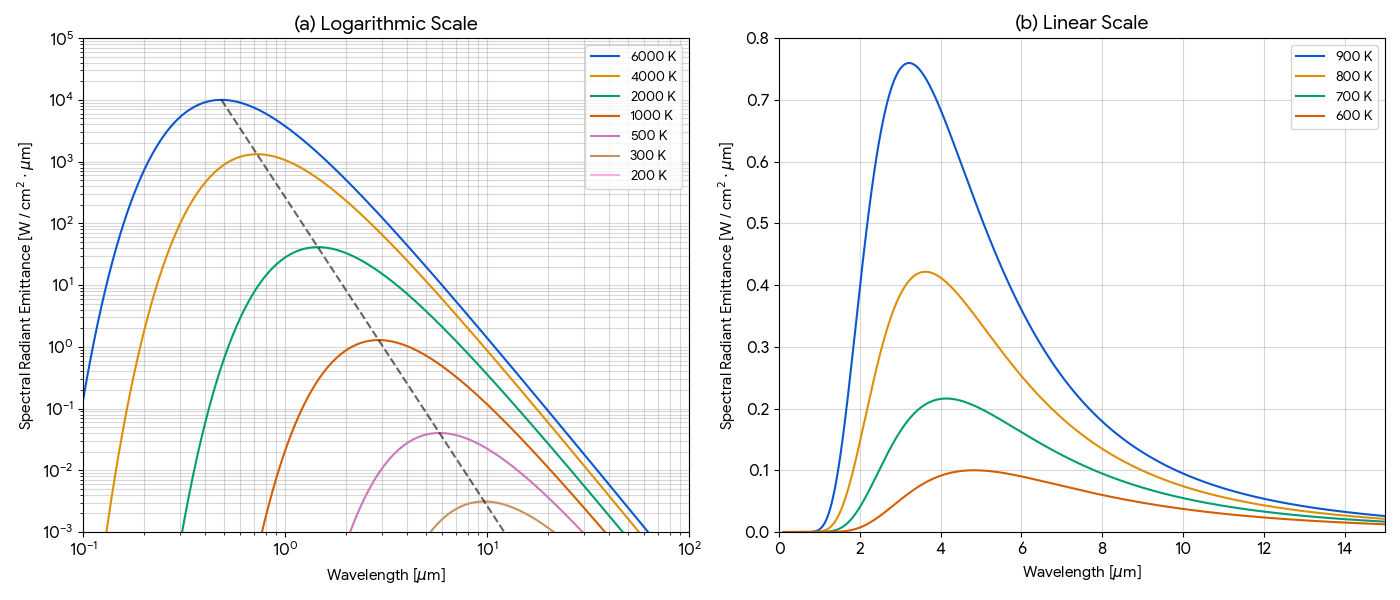
As shown in the spectral emittance graphs, hotter objects emit much more energy and shift toward shorter wavelengths. Precise FOV alignment is critical to ensuring accurate temperature measurements.
Distance-to-Spot (50:1 Ratio)
The table below shows how the measurement area (Spot Size) expands as you move further from a target.
| Distance to Target | Measurement Spot Diameter |
|---|---|
| 1 meter (100 cm) | 2 cm |
| 2 meters (200 cm) | 4 cm |
| 5 meters (500 cm) | 10 cm |
| 10 meters (1000 cm) | 20 cm |
Spectral Radiant Emittance
Planck’s Law describes the spectral distribution of energy for any specific temperature over all of the wavelengths. Radiant emittance is the power emitted from a surface, Spectral radiant emittance characterizes the radiant emittance per wavelength.